In business, growth doesn’t usually fail because of a lack of effort, talent, or ambition—it fails because of a hidden constraint. What is a bottleneck in business?
It’s the single point in your operation where momentum slows, opportunities pile up, and progress quietly bleeds away while everything else appears to be working. Bottlenecks don’t announce themselves with alarms; they disguise themselves as “busy weeks,” “temporary delays,” or “we’ll fix it later.” Yet left unchecked, one bottleneck can silently cap revenue, exhaust teams, and stall scaling no matter how hard you push.
In this article, you’ll learn how to spot the exact friction point holding your business back—and why fixing it can unlock growth faster than any new marketing tactic, hire, or software ever could.
If you’re smart enough to read this entire article, and I know you are, you will become your company’s bottleneck detective! OK. Now let’s talk about what is a bottleneck in business, and more importantly, what you can do about it.
Key Takeaway
A bottleneck in business is the constraint that limits how fast the entire organization can move. Identifying and removing bottlenecks allows companies to increase output, improve efficiency, and scale without increasing pressure on their teams.
Bottleneck Definition
What Is a Bottleneck in Business
A bottleneck in business is any point in a system where demand exceeds capacity, causing work to slow down, stall, or pile up. Picture a literal bottle: no matter how much liquid you pour in, only a limited amount can pass through the narrow opening at once. Businesses behave the same way.
A bottleneck can live in a workflow, a process, a person, a technology, or a decision structure. When one step can’t keep pace, everything downstream suffers—even if the rest of the organization appears strong.
This matters because a business can only grow at the speed of its slowest constraint. Revenue, impact, and scale are governed not by your best-performing areas, but by the one place where flow breaks down.
Actionable tip: Stop looking for what’s “working best.” Start looking for where work consistently slows, waits, or backs up—that’s where the bottleneck usually lives.
Strategic Insight
Why bottlenecks limit growth even in successful companies
Bottlenecks often appear when companies grow faster than their systems evolve. Processes that worked at earlier stages become overloaded as demand increases. The result is slower execution, rising internal friction, and teams spending more energy navigating processes than producing results.
Diagnostic Insight
How to recognize a bottleneck inside your organization
A bottleneck usually reveals itself where work consistently stalls, waits for approval, or requires repeated clarification. Teams may feel busy but progress slows because tasks depend on a constrained step or decision point.
Why Bottlenecks Are the Silent Killers of Growth
Bottlenecks rarely announce themselves as the problem. Instead, they disguise themselves as normal business friction: long days, constant firefighting, or the feeling that everyone is busy but nothing feels easier.
When a bottleneck exists:
Teams feel stretched but not effective
Opportunities stall mid-stream
Leaders compensate with urgency instead of clarity
Growth plateaus despite increased effort
This is why growth often feels harder right before it stops. You’re not failing—you’re pushing against a constraint.
Most businesses don’t lack ideas or motivation. They lack flow.
Actionable tip: If effort is increasing faster than results, pause. That widening gap is often the earliest signal of a bottleneck limiting growth.
Capacity, Demand, and the Physics of Business
Every business operates at the intersection of capacity and demand, and that relationship behaves less like motivation and more like physics. Demand represents how much opportunity, work, or attention is flowing into your business, while capacity defines how much your people, systems, and workflows can realistically handle without breaking down. When demand rises faster than capacity at any point in the process, a bottleneck is inevitable—and no amount of urgency or effort can override that imbalance for long.
When capacity and demand fall out of alignment, the strain doesn’t show up all at once—it concentrates. That pressure always surfaces next inside your workflows, where work slows, decisions wait, and friction quietly reveals exactly where the bottleneck lives.
Demand is how much work, opportunity, or attention flows into your business.
Capacity is how much your systems, people, and workflows can handle without strain.
A bottleneck forms the moment demand outpaces capacity at a specific point in the process.
This could be:
Too many leads for one decision-maker
Too many clients for one delivery team
Too many approvals for one executive
When capacity is misaligned with demand, stress accumulates silently. Performance degrades long before revenue reflects it.
Actionable tip: Map where demand is rising fastest—and compare it to capacity at each step. The mismatch reveals the bottleneck.
How Bottlenecks Hide Inside Workflows
Most bottlenecks don’t live in obvious failures—they live inside workflows. A workflow is simply how work moves from start to finish, and inefficient workflows quietly restrict growth.
Common workflow bottlenecks include:
Excessive handoffs
Unclear ownership
Manual steps inside scalable systems
Approval chains that delay decisions
When workflows are inherited instead of designed, friction becomes invisible. Teams compensate by working harder instead of fixing the system.
Over time, inefficient workflows drain energy, morale, and momentum.
Actionable tip: Document one core workflow from start to finish. Wherever work pauses or loops backward, you’ve found a likely bottleneck.
“You don’t scale a business by pushing harder—you scale it by widening the narrowest point that controls everything else.”
Dr. Stephie Althouse
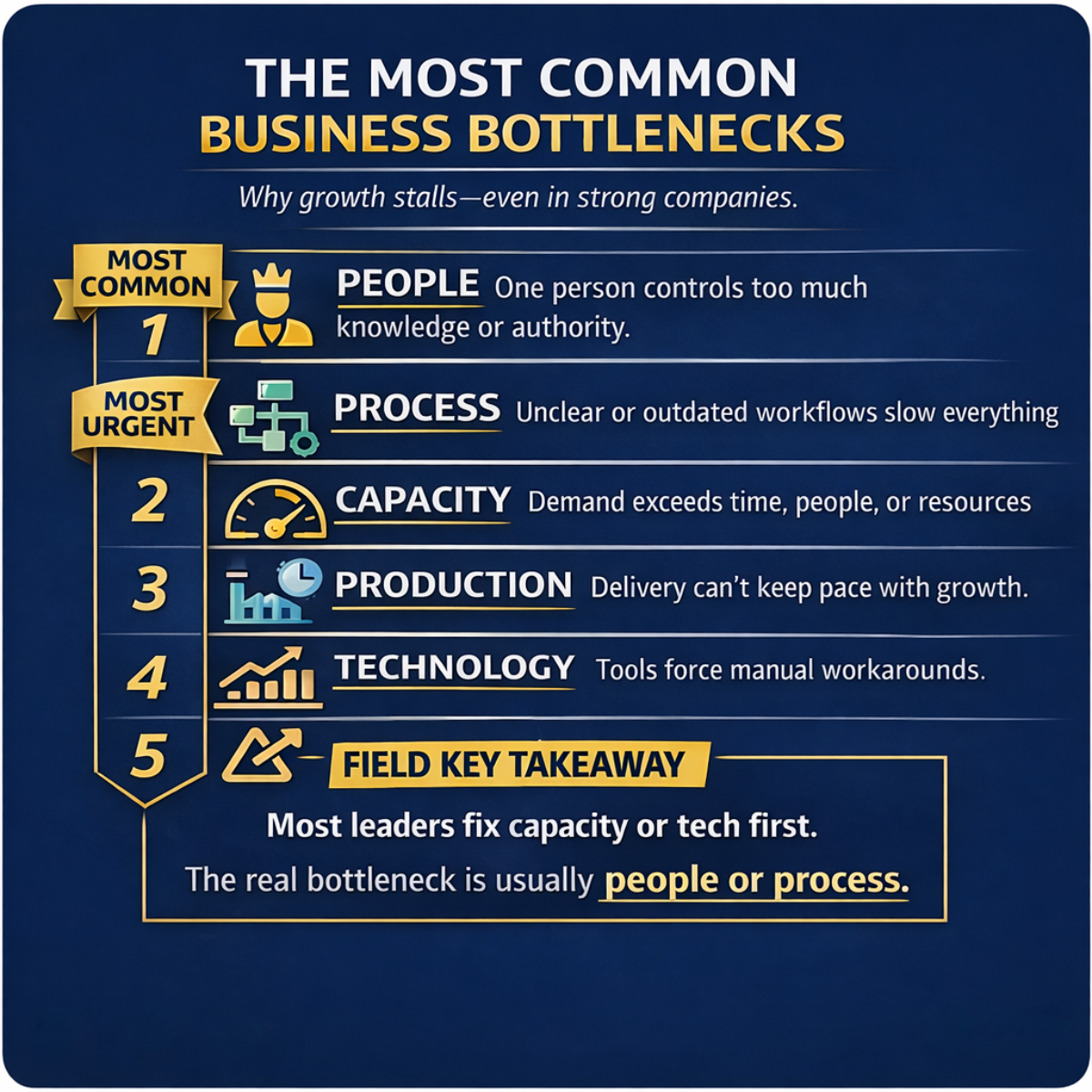
The Most Common Types of Business Bottlenecks
While every organization is unique, most bottlenecks fall into predictable categories that show up again and again across industries, company sizes, and stages of growth. Recognizing these patterns matters, because leaders often waste time fixing symptoms when the real constraint fits one of these familiar forms. Most bottlenecks aren’t mysterious—they’re simply misunderstood.
While every organization is unique, most bottlenecks fall into predictable categories:
People Bottlenecks(Most Frequent & Most Dangerous)
A people bottleneck occurs when too much knowledge, authority, or decision-making power is concentrated in one person.
Why it’s severe: This bottleneck scales pressure, not output. As demand grows, that individual becomes overwhelmed, slowing the entire organization.
Diagnostic question: If this one person were unavailable for two weeks, what would stop moving immediately?
Process Bottlenecks(High Frequency, High Impact)
Process bottlenecks form when outdated, unclear, or overly complex processes slow execution and create unnecessary friction.
Why it’s severe: Teams spend energy navigating the process instead of producing results, quietly eroding morale and efficiency.
Diagnostic question: Where do tasks regularly get stuck, rerouted, or sent back for clarification
Capacity Bottlenecks(Moderate Frequency, High Visibility)
Capacity bottlenecks occur when there simply aren’t enough people, time, or resources to handle current demand.
Why it’s severe: This bottleneck often appears during growth spurts and creates burnout if left unresolved.
Diagnostic question: Where are people consistently working harder just to keep up, not get ahead
Production Bottlenecks(Moderate Frequency, Long-Term Risk)
A production bottleneck is a capacity constraint in a manufacturing process or business workflow where input exceeds throughput, limiting overall output.
The effect is the same: the whole operation slows to the speed of that constraint.
Why it’s severe: They damage customer experience and reputation, often after marketing has already succeeded.
Diagnostic question: Where does delivery slow down as sales or volume increase?z
Technology Bottlenecks(Lower Frequency, High Friction)
Technology bottlenecks happen when tools, platforms, or systems can’t support current workflows or scale with growth.
Why it’s severe: They create workarounds that introduce errors, delays, and frustration.
Diagnostic question: Which tools require manual fixes, duplicate work, or constant exceptions to function?
Why This Ranking Matters
Most leaders assume capacity or technology is the problem—but in reality, people and process bottlenecks are far more common and far more limiting to growth. Fixing the wrong category first often increases pressure on the true constraint instead of relieving it.
Identifying Bottlenecks Before They Stall Momentum
Identifying bottlenecks requires observation—not assumptions. It also requires the discipline to slow down long enough to study how work actually moves through the business, rather than how leadership believes it should move. Most bottlenecks persist because they’re masked by urgency, not because they’re invisible. Teams often work around constraints instead of naming them, unintentionally hiding the very friction leaders need to see.
A Simple Diagnostic Framework for Identifying Bottlenecks
Use this quick, practical lens to surface constraints without overcomplicating the process:
Where does work wait? Tasks sitting idle almost always signal a bottleneck.
Where does work return? Rework and revisions often point to unclear processes or decision constraints.
Where does work rely on one person? Single points of approval are among the most common growth limiters.
Where does urgency spike repeatedly? Chronic “fire drills” indicate structural friction, not temporary issues.
Where does demand outpace follow-through? This gap often reveals capacity or production bottlenecks.
Actionable takeaway: Instead of asking, “Who’s slowing things down?” ask, “Where is the system forcing slowdowns?” Bottlenecks live in structures, not people.
A Short Micro-Story: When the Real Bottleneck Finally Revealed Itself
One founder had built a fast-growing professional services firm. Revenue was climbing. The pipeline was full. The team was working nights and weekends. Yet profits stalled, and burnout was spreading.
Leadership assumed the bottleneck was staffing—so they hired more people. The pressure got worse.
Only when they mapped the workflow did the real constraint appear: every major decision still required the founder’s approval. Demand had scaled. Capacity had not. The bottleneck wasn’t effort—it was control.
Once decision authority was redesigned, output increased within weeks. Nothing else changed.
Actionable tip: If growth feels heavy instead of energizing, examine where decisions—not tasks—are getting stuck.
Why Fixing the Wrong Bottleneck Backfires
One of the most expensive mistakes businesses make is optimizing areas that are not the bottleneck—but it rarely feels like a mistake in the moment. On the surface, these efforts look responsible: new tools are implemented, processes are refined, dashboards improve, and teams appear more productive.
Yet beneath that activity, the business remains stubbornly slow in the one place that actually controls momentum. This is where leaders become confused—because everything looks better, feels busier, and costs more, while growth stays flat.
Improving non-constrained areas:
Increases pressure on the true bottleneck
Creates frustration instead of relief
Produces local efficiency without global improvement
This is why new tools, hires, or initiatives often disappoint. They weren’t aimed at the real constraint.
Actionable tip: Before investing, ask: “If this improves, will overall flow improve—or just one par
Eliminating Bottlenecks the Smart Way
Some good news, is eliminating bottlenecks doesn’t always require more resources—and this is where many leaders finally exhale. The instinct to hire, buy, or push harder is understandable, but it’s rarely the most effective move. In reality, the fastest breakthroughs usually come from redesigning how work flows, how decisions are made, and how responsibility is distributed.
When a bottleneck is addressed at the design level, momentum returns without burnout, and growth feels lighter instead of heavier.
Effective strategies include:
Simplifying processes
Redesigning workflows for flow
Aligning capacity with real demand
Removing unnecessary approvals
Eliminating bottlenecks unlocks trapped momentum that already exists inside the business.
Actionable tip: Remove friction before adding complexity. Simplification almost always beats expansion first.
Production Bottlenecks and the Hidden Ceiling on Growth
Production bottlenecks occur when delivery can’t keep pace with demand—and they often surface at the most misleading moment: right after growth appears to be working. Sales are up, interest is high, and momentum feels real, yet behind the scenes, fulfillment slows, teams strain, and quality begins to slip.
This is where growth quietly turns fragile. What looks like success on the front end can quickly become reputational damage on the back end if production bottlenecks aren’t identified and addressed early.
The earliest warning sign of a production bottleneck is when delivery timelines start slipping even though nothing about your offer, pricing, or team quality has changed.
Sales growth creates opportunity; production bottlenecks turn that opportunity into risk.
Common examples include:
Limited fulfillment capacity
Overloaded service teams
Manual production steps
Quality control slowdowns
Unchecked production bottlenecks damage trust, reputation, and retention—even while sales look strong.
Actionable tip: Track delivery timelines as closely as sales metrics. Delays signal production bottlenecks early.
How the Brilliance Revolution Reveals and Eliminates Bottlenecks
The Brilliance Revolution methodology, called Brilliance Mining System(TM), by Dr. Stephie Althouse, was designed specifically to expose the hidden constraints that limit growth before leaders realize they exist.
Rather than treating symptoms, it examines:
How value flows through workflows
Where decision authority constricts capacity
How demand and execution fall out of alignment
By revealing the true bottleneck—and prioritizing eliminating bottlenecks in the correct order—leaders regain momentum without burning out teams.
This systems-level clarity is why organizations using the methodology experience smoother, more sustainable growth.
Actionable tip: Shift from problem-solving to constraint-solving. Growth accelerates when you fix the system, not the symptoms.
Why Bottlenecks Move as Businesses Grow
Here’s the truth most leaders miss: bottlenecks don’t disappear—they move, and when they go unnoticed, they quietly undermine everything that growth was meant to achieve. What once worked smoothly begins to strain, familiar workflows start to fail, and leaders are left reacting to symptoms they don’t recognize as structural.
The danger isn’t the new bottleneck itself—it’s continuing to operate as if yesterday’s constraints are still the problem, while today’s are silently reshaping outcomes.
They are real-world consequences. When moving bottlenecks go unnoticed, revenue leaks through missed opportunities, morale erodes as teams compensate for broken workflows, and reputation suffers as once-reliable delivery becomes inconsistent.
Diagnostic question: 👉 What part of the business feels harder than it did six months ago—even though we’re more experienced and better resourced?
As growth increases:
Demand shifts
Capacity requirements change
New workflows form
High-performing organizations don’t panic when new bottlenecks appear. They expect them.
Actionable tip: Schedule quarterly constraint reviews. What limited growth last quarter may no longer be the bottleneck today.
Building a Culture That Anticipates Bottlenecks
Sustainable growth requires a culture that treats bottlenecks as signals, not failures—and that distinction changes everything. In organizations where bottlenecks are feared or blamed, teams hide friction, work around constraints, and exhaust themselves compensating for broken systems. In cultures that anticipate bottlenecks, constraints are surfaced early, discussed openly, and addressed deliberately before they harden into limits on growth. The difference isn’t talent or effort—it’s psychological safety around truth.
Real-world consequences: When bottlenecks are treated as failures, teams burn out, innovation slows, and leaders lose visibility into where growth is actually being constrained.
That culture values:
Systems thinking
Transparency
Flow over heroics
Clarity over urgency
When teams feel safe identifying bottlenecks, performance improves naturally.
Actionable tip: Reward clarity, not overwork. Businesses that fix workflows outperform those that celebrate burnout.
Final Thoughts: The Invisible Ceiling Above Every Business
So, what is a bottleneck in business? It’s the invisible ceiling that determines how far, how fast, and how sustainably you can grow.
Whether it lives in workflows, capacity, demand alignment, or production bottlenecks, it quietly controls outcomes.
The fastest-growing organizations aren’t the ones that push harder—they’re the ones that master identifying bottlenecks and systematically eliminating bottlenecks as they appear.
Final actionable tip: Stop asking, “How do we grow faster?” Start asking, “What’s the one constraint limiting us right now?”
Next Steps: Turn Insight Into Momentum
Understanding bottlenecks is powerful—but insight alone doesn’t change outcomes. What changes a business is action taken at the right leverage point, in the right order. If this article helped you recognize where growth may be quietly constrained, here are three simple next steps you can take—starting exactly where you are.
1. Register for a Free Chapter of Ignite Your Brilliance Revolution
If you want to understand why bottlenecks form—and how to dismantle them systematically—start with Ignite Your Brilliance Revolution. This is not a motivation book or a collection of tactics. It’s a practical framework for revealing hidden vulnerabilities, redesigning workflows, and removing the invisible ceilings that limit growth.
Right now, the book is in its final stages of publication. You can register for a free chapter and be placed on the official release list so you’re notified the moment it becomes available.
2. Discover One Hidden Vulnerability in a 15-Minute Complimentary Call
Every business has at least one hidden vulnerability limiting performance—often in a place leadership isn’t looking. In a 15-minute complimentary call, you’ll walk through a focused, high-level review designed to surface one specific constraint affecting your growth right now. No pitch. No prep. Just clarity you can act on immediately.
Promise of value: You will leave the call knowing one real bottleneck you can address—whether you choose to work together or not.
3. Improve Your Business Today—With Personalized Insight
If you prefer to reflect before you speak, start here. Complete a short diagnostic questionnaire designed to reveal early warning signs of bottlenecks across workflows, decision-making, capacity, and culture. Dr. Steffi will personally review your responses and email you back with one tailored insight or recommendation you can apply immediately—no generic feedback, no automation.
Promise of value: You’ll receive a personalized response pointing to one practical action that can improve flow, clarity, or momentum in your business today.
Call to action: 👉 Fill out the questionnaire and receive your personalized insight directly from Dr. Stephie.
Final note: You don’t need to fix everything at once. You just need to identify—and address—the one constraint that matters most right now. These next steps are designed to help you do exactly that.
For additional resources and insight into Dr. Stephie’s methodology, Brilliance Mining, click here. For background into her turn around stories and CEO training, visit Top Notch CEO here.
FAQs
How can I identify bottlenecks in my company?
You identify most bottlenecks by tracking: – Where work consistently slows – Queues form – Decisions stall – Additional hiring appears to be requires – Rework increases
What is a bottleneck in business?
A bottleneck in business is the point in a process where limited capacity slows the flow of work for the entire system. When one step cannot handle the volume of incoming tasks, everything behind it begins to queue. This constraint reduces productivity, delays output, and limits how fast a company can grow until the bottleneck is removed.
What causes bottlenecks in business processes?
Bottlenecks in growing companies usually form when processes, decision flows, or key roles cannot keep up with increasing demand. As businesses scale, workflows that once worked well begin to slow execution. Common causes include overloaded decision-makers, outdated processes, and undocumented knowledge that only a few people possess.
Why are bottlenecks dangerous for business growth?
Bottlenecks are dangerous because they cap the total output of an entire organization. Even when teams work harder, production cannot exceed the capacity of the constraint. Over time this leads to missed opportunities, employee frustration, and slower revenue growth.
How do you eliminate bottlenecks?
Eliminating bottlenecks involves redesigning workflows, aligning capacity with demand, simplifying processes, and removing unnecessary, unseen constraints.
Do bottlenecks go away permanently?
No. Bottlenecks shift as businesses grow. High-performing organizations continuously identify and address new constraints.
What is the difference between a process bottleneck and a people bottleneck?
A process bottleneck occurs when workflow design slows execution, such as complex approval chains or unclear procedures. A people bottleneck occurs when too much knowledge or authority depends on one individual, forcing work to wait for that person’s involvement.
About The Author
Dr. Stephie Althouse is the founder of The Brilliance Revolution™ and the creator of the Brilliance Mining™ methodology, a system designed to help growing companies uncover hidden knowledge, eliminate operational bottlenecks, and scale without losing their most valuable expertise.
For more than three decades, she has helped founders and leadership teams identify the unseen constraints limiting growth and transform individual brilliance into scalable organizational systems.
Her work focuses on companies between $5 million and $100 million in revenue, where growth often slows not from lack of effort, but from hidden knowledge bottlenecks.
Related Topics: Business bottlenecks • process bottlenecks • operational constraints • business scalability • knowledge bottlenecks