
I’m going to begin with a bold statement that will become clear as you read on. Strategic Clarity Is the Foundation of Sustainable Growth.
In this article, I’ll talk about what it is, reveal when the fog sets in, and how to recognize it. In each section, I’ll give you a concrete action you can take.I write my blog articles so that each one gives you, the business leader, clarity, value, and concrete actions that you can use to help your company grow more smoothly and with less stress.
A founder running a $9M company told me recently:
“My team is busy every day… but nothing actually moves forward.”
That’s strategic fog.
There is a moment in the life of almost every growing company when success begins to feel heavier than it should.
Revenue is rising.
The team is larger than it was a year ago.
The calendar is full of activity.
From the outside, everything appears to be working.
Yet, inside the organization, something feels different.
Decisions take longer.
Execution slows down.
Meetings multiply but don’t always produce clarity.
Momentum that once felt natural now feels harder to sustain.
Many founders experience this moment quietly. The business is still growing, but progress suddenly requires more effort than before.
For founders and CEOs, this shift is difficult to ignore.
When an organization begins to slow down, the responsibility for addressing this issue almost always falls on the leadership. You feel the friction first. Conversations stretch longer. Decisions require more alignment. What once felt like momentum now feels like management.
Most leaders assume this is a strategy problem. They respond by creating new initiatives, expanding planning sessions, or introducing additional frameworks.
But in many growing companies, the real issue is something less obvious and far more powerful:
A lack of strategic clarity.
Strategic clarity is the force that allows organizations to convert intelligence into action. Without it, even highly capable teams experience friction, misalignment, and stalled momentum.
When strategic clarity disappears, growth does not necessarily stop — but it becomes far more difficult than it should be.
What Strategic Clarity Really Means in a Growing Company
Strategic clarity in business is often misunderstood. Many leaders assume clarity simply means having a strategy document or a clearly written set of goals.
But real strategic clarity goes much deeper.
Strategic clarity exists when leadership teams share a unified understanding of the company’s direction, priorities, and decision filters. It ensures that people across the organization understand not only what the company is trying to achieve, but also how decisions should be made along the way.
When strategic clarity is strong, organizations move quickly. Teams make decisions confidently. Resources flow toward the right opportunities.
When clarity is weak, organizations experience subtle friction that gradually slows progress.
Strategic clarity creates alignment in three critical areas:
- Decision clarity – leaders know how to evaluate opportunities and trade-offs
- Execution clarity – teams understand what matters most right now
- Leadership clarity – senior leaders operate from the same strategic understanding
Without these forms of clarity, intelligence inside the organization begins to fragment. Departments may move forward individually, but not always in harmony.
Action Step
Ask a simple but revealing question within your leadership team:
If three executives described the company’s top strategic priorities today, would their answers match?
If the answers differ significantly, strategic clarity may already be slipping.
The Hidden Cost of Strategic Fog
Strategic fog rarely announces itself dramatically. It rarely appears as a single obvious crisis.
Instead, it shows up through subtle operational signals scattered across the organization.
Because the symptoms appear in different places, leaders often interpret them as separate problems. But many of these signals share the same underlying cause. A lack of strategic clarity.
When clarity fades, decisions slow. Energy disperses. Alignment weakens.
Common symptoms of strategic fog
- The same issues reappear across multiple departments
- Leadership meetings circle around the same conversations
- Projects stall between teams
- Growth requires more effort than it once did
- High performers operate below their capability
These signals usually emerge gradually. At first, they appear manageable. Over time, they accumulate and begin to drain the organization’s momentum.
Action Step
Look for recurring friction inside your organization. When the same challenges reappear in different places, they often point to a deeper clarity issue upstream.
Why Growth Itself Often Creates Strategic Fog
Ironically, the growth leaders work so hard to achieve often introduces the conditions that weaken strategic clarity.
As organizations expand, complexity grows alongside them.
More people join the company.
More departments emerge.
More opportunities compete for leadership attention.
What once felt intuitive now requires coordination and interpretation.
Without intentional strategic clarity, this expanding complexity begins to cloud decision-making.
Three forces that naturally create strategic fog
1. Organizational expansion
More people bring more perspectives, assumptions, and interpretations of strategy.
2. Opportunity overload
As success grows, leaders encounter more opportunities than they can realistically pursue.
3. Leadership bandwidth limits
Founders who once made every decision must now rely on distributed leadership teams.
None of these forces are negative. They are natural stages of growth.
But without strategic clarity, they create fog.
Action Step
Identify where complexity has increased most inside your company during the past two years. Those areas often reveal where strategic clarity is beginning to weaken.
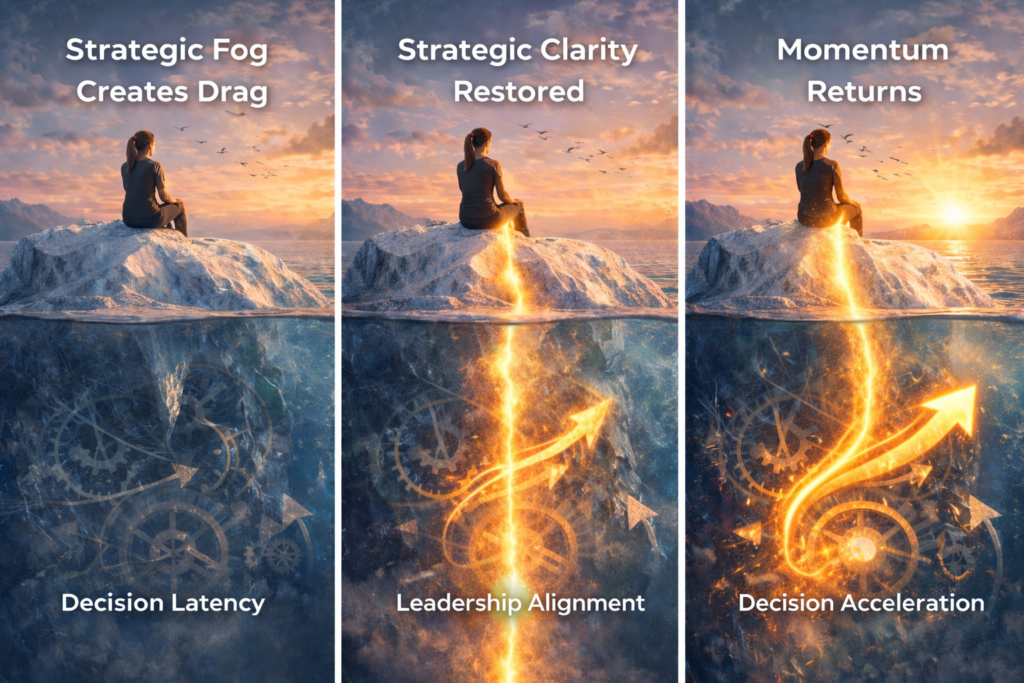
Why Smart Companies Lose Strategic Clarity
One of the most misunderstood truths about leadership is this:
Strategic clarity does not disappear because companies become less intelligent. It disappears because they become more complex.
In early-stage companies, clarity often exists naturally. The founder holds the strategy in their mind, and the team is small enough that direction spreads organically.
Decisions move quickly because everyone understands the priorities. But success changes the system.
Growth introduces new leaders, new departments, new interpretations of strategy, and more possible directions. The organization becomes smarter — but also more complicated.
Without deliberate effort to maintain clarity, complexity begins to generate fog.
Framework: The Strategic Clarity Drift
Most companies experience a gradual drift in clarity caused by three forces:
Interpretation expansion
As leadership teams grow, more people interpret strategy through their own experiences and assumptions.
Priority competition
New opportunities emerge faster than leaders can evaluate them.
Structural complexity
As departments expand, coordination replaces intuition.
None of these forces signal failure. In fact, they are often signs that the company is succeeding.
But without strategic clarity, they slow the organization down.
Action Step
Ask your leadership team a revealing question:
Where do we see the most interpretation of strategy rather than execution of it?
Where interpretation grows, strategic clarity is often fading.
The 4 Signals That Strategic Clarity Is Slipping
Strategic fog can be difficult to recognize because it spreads gradually through the organization.
However, several signals appear consistently in companies experiencing declining strategic clarity.
Framework: The 4 Signals of Strategic Fog
1. Decision latency
Important decisions take longer than they should because priorities are unclear.
2. Meeting multiplication
Teams meet frequently but leave without resolution.
3. Execution drag
Projects require more coordination and oversight than before.
4. Leadership misalignment
Senior leaders subtly pursue different interpretations of strategy.
When these signals appear together, they often indicate a strategic clarity problem rather than a talent or effort problem.
Action Step
Review your leadership meetings over the past month. Are they producing clear decisions, or simply circulating information?
The answer can reveal a great deal about the organization’s current level of strategic clarity.
Why Adding More Strategy Often Makes the Problem Worse
When leaders sense friction inside their companies, their instinct is usually to add more strategy.
More initiatives.
More frameworks.
More strategic planning sessions.
Unfortunately, this often intensifies the problem.
When strategic clarity is missing, adding additional strategic layers creates more interpretation instead of resolution. Teams receive more ideas but less clarity about which priorities truly matter.
Why this happens
- New initiatives compete with existing priorities
- Strategic conversations expand rather than narrow focus
- Leaders attempt to solve clarity problems with planning exercises
The organization becomes busy, but not necessarily aligned.
Action Step
Examine how many major initiatives are currently underway across the company. If several projects compete for leadership attention, the organization may need clarity rather than additional strategy.
Strategic Clarity Restores Momentum
When strategic clarity returns to an organization, the shift is often noticeable almost immediately.
- Decisions accelerate because priorities become obvious.
- Leadership conversations become shorter and more decisive.
- Teams move forward with confidence because they understand how decisions should be made.
- Many leaders describe the experience as if friction has been removed from the system.
What once required multiple conversations now resolves quickly. What once felt complicated becomes straightforward.
And momentum — the momentum that fueled the company’s early growth — begins to return.
Strategic clarity restores
- Faster decision cycles
- Stronger leadership alignment
- Greater confidence across teams
- Better use of organizational intelligence
In many companies, the talent and ideas needed for growth already exist. Strategic clarity simply allows them to operate at full capacity.
Action Step
Consider where decision-making slows most often inside your organization. That location often reveals where strategic clarity needs to be restored.
How Strategic Clarity Supports Founder Evolution
As companies grow, founders often face a significant leadership transition.
Early-stage businesses typically rely on founder intuition. The founder makes most strategic decisions and communicates direction directly to the team.
But as organizations scale, that model becomes difficult to sustain.
Without strategic clarity, founders unintentionally become decision bottlenecks.
Common leadership transition challenges
- Founders remain the final decision-maker for too many issues
- Leadership teams lack clarity to make independent decisions
- Strategic discussions rely heavily on the founder’s interpretation
Strategic clarity allows founders to scale leadership without losing direction. It converts personal insight into organizational intelligence.
Action Step
Observe how often teams seek confirmation before moving forward. Frequent confirmation requests may indicate that stronger strategic clarity is needed across leadership.
How the Brilliance Revolution Methodology Helps Eliminate Strategic Fog
Strategic clarity rarely emerges from traditional planning sessions alone.
Instead, clarity often returns when leaders identify the hidden dynamics that shape how decisions move through the organization.
Using the methodologies behind The Brilliance Revolution, leadership teams examine the patterns that create friction inside growing companies.
Rather than adding additional frameworks, the process focuses on identifying the underlying sources of fog that slow momentum.
Framework: The Strategic Clarity Reset
Organizations often regain clarity by addressing three core areas:
1. Identifying hidden bottlenecks
Certain individuals, processes, or assumptions may quietly slow decision flow.
2. Restoring leadership alignment
Ensuring senior leaders operate from a shared understanding of strategy.
3. Re-establishing decision filters
Clarifying how opportunities should be evaluated and prioritized.
When these elements align, strategic clarity begins to reappear naturally.
Decisions accelerate. Teams operate with greater confidence. Momentum begins to return.
Action Step
Reflect on where the most important decisions in your organization slow down. Those moments often reveal the hidden structures that the Brilliance Revolution methodologies are designed to uncover.
Strategic Clarity Is the Foundation of Sustainable Growth
Many companies believe sustainable growth requires constant expansion of strategy.
But long-term growth depends on something simpler and far more powerful:
Clarity.
Strategic clarity ensures that intelligence inside the organization moves in the same direction. It allows leaders to convert insight into action and opportunity into momentum.
Without clarity, even highly capable teams struggle to move efficiently.
With clarity, organizations rediscover the speed and confidence that fueled their early success.
Conclusion: Strategic Clarity Changes Everything
If growth inside your organization has begun to feel heavier than it should, you may not be facing a strategy problem.
You may be facing a strategic clarity problem.
Strategic fog often develops slowly inside growing companies. It hides behind meetings, initiatives, and expanding complexity until leaders begin to notice that momentum is harder to sustain.
But once clarity returns, organizations often rediscover something powerful:
Speed.
Confidence.
Alignment.
Using the methodologies behind The Brilliance Revolution, leadership teams frequently discover that the intelligence required to move forward was never missing. What was missing was clarity about how that intelligence should move through the company.
And once that clarity returns, progress accelerates again.
If parts of this article feel familiar inside your organization, the next step is simple.
Start a conversation Dr. Stephie to explore where strategic fog may be forming inside your company.
In a short discussion, it is often possible to identify the hidden patterns slowing momentum — and uncover where strategic clarity can begin to return. If you find our initial conversation helpful, we can go from there.
Because when strategic clarity improves, everything inside the organization tends to move faster.
To learn more about Dr. Stephie, click here. To request your personalized conversation, fill out the form on this page.
Resources
Download our complementary guide to how SOPs can transform your business.
How can Key Person Risk affect your business. Find out here.
FAQs
What is strategic clarity in business?
Strategic clarity in business means leadership teams share a clear understanding of the company’s priorities, direction, and decision filters. When strategic clarity exists, leaders and teams know what matters most and how decisions should be made. This alignment allows organizations to move faster, allocate resources effectively, and maintain momentum during periods of growth.
Why do growing companies lose strategic clarity?
Growing companies often lose strategic clarity because success increases organizational complexity. As teams expand, more leaders interpret strategy differently, new opportunities compete for attention, and decision-making becomes distributed. Without deliberate alignment, these factors create strategic fog that slows execution and makes growth feel harder than it should.
What are the signs a company lacks strategic clarity?
Common signs of weak strategic clarity include slow decision-making, frequent meetings without resolution, projects stalling between teams, leadership misalignment, and growth requiring more effort than before. These symptoms often appear gradually and signal that priorities, decision filters, or leadership alignment may no longer be clear across the organization.
How does strategic clarity improve business performance?
Strategic clarity improves business performance by accelerating decisions, aligning leadership teams, and focusing resources on the most important opportunities. When organizations have strong strategic clarity, teams execute more confidently, collaboration improves, and momentum returns because everyone understands how strategy should guide day-to-day decisions.
Why doesn’t adding more strategy solve strategic clarity problems?
Adding more strategic initiatives rarely solves strategic clarity problems because the issue is usually not a lack of plans but a lack of alignment. When clarity is missing, additional initiatives create more interpretation rather than focus. Organizations often need clearer priorities and decision filters, not more strategy.
How can leadership teams restore strategic clarity?
Leadership teams restore strategic clarity by identifying the hidden patterns that slow decisions, realigning around shared priorities, and establishing clear decision filters. Using structured leadership methodologies, companies can remove strategic fog, strengthen alignment, and enable teams to execute more efficiently as the organization grows.
